South Australia
A missed call is a job that went to somebody else.
Andy is a scheduling assistant with one job. When a trades business cannot get to the phone, Andy picks it up, writes down what the caller wants and offers a time out of the diary that already exists.
One address, read by a person. Say the trade and the suburb you work out of, and you get an answer inside 5 business days.
The narrow claim
01One missed call, turned into a booked job
The whole product is the ninety seconds after a phone rings out. Nothing before it, nothing after it.
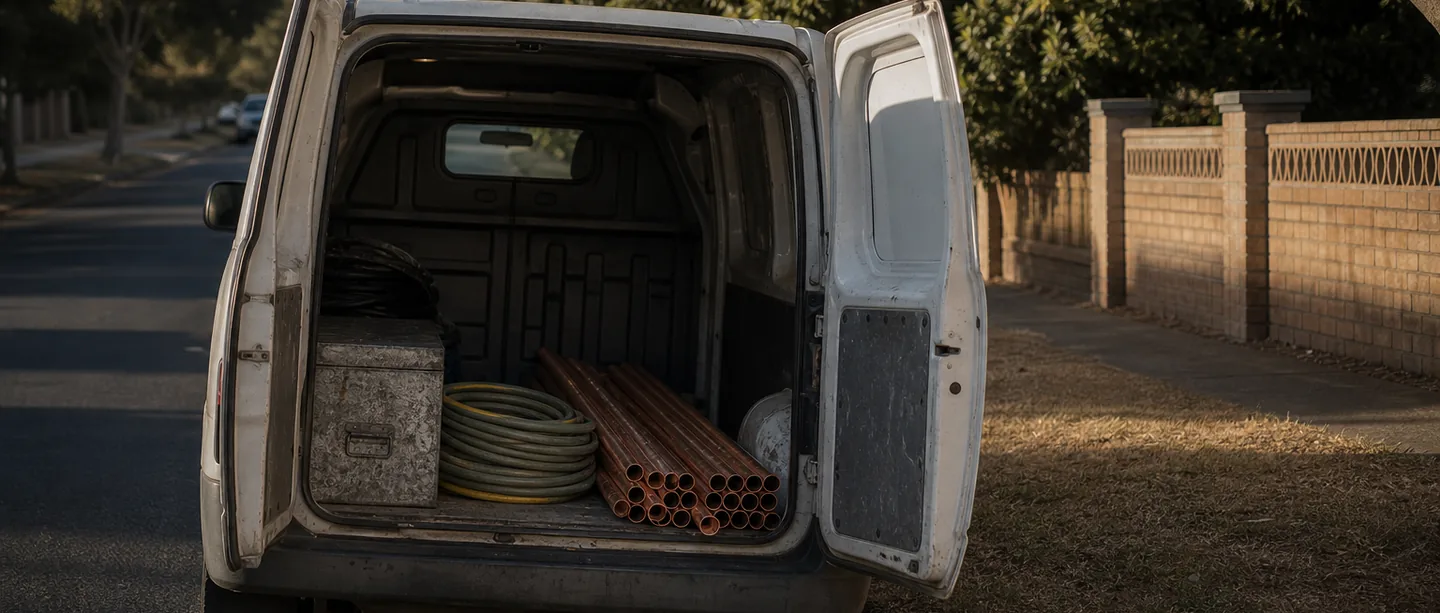
A sole trader with a van and a phone loses work in a very specific way. The phone rings while both hands are inside a wall cavity. It rings again from the top of a ladder. It rings during the one job that cannot be paused. By the time it is safe to look at the screen there are four missed calls, and at least two of those people have already rung the next name on the list.
The usual advice is to hire somebody to answer the phone, or to put in a call centre, or to adopt a system. All three are answers to a bigger problem than the one being described. The problem being described is that a stranger rang, nobody picked up, and there is now no record of what they wanted.
Andy sits in exactly that gap. It answers when you do not, takes the details in plain speech, offers a time from the diary you already keep, and sends you one message about what happened. You do not open an app, you do not type, and you do not learn anything.
If a tradesperson has to type to make it work, it has failed. If a tradesperson has to keep a second diary, it has failed. If the caller has to be told they are speaking to software before they will say what they want, then the caller was owed that, and we would rather it be said at the start of the call than discovered later.
Scope
02What it does, and what it will never do
A scope table is only useful when the second half of it is honest. The right column says whether a job is in or out.
The right-hand column is the one to read first. Five rows in it say out, and those five decide what Andy is, because they are the work it turns down on purpose and always will.
| Item | What it actually does | In or out |
|---|---|---|
| Answer a call you did not get to | Picks up after you decline or after it rings out, speaks in plain language, and does not pretend to be you | In |
| Take the details | Name, a callback number, the suburb, and a sentence in the caller's own words about what has gone wrong | In |
| Text the caller straight away | One message while the phone is still in their hand, confirming that a real person now has their details and when they will hear back | In |
| Offer a time from your diary | Reads the space that is genuinely free in the calendar you already use and offers two options. It does not invent availability to close a call | In |
| Write the booking back | Puts the job in the same calendar, with the caller's number and the sentence they said, so the entry is useful on the way there | In |
| Tell you what happened | One message at the end of the day. Calls taken, jobs booked, callers who wanted something you do not do | In |
| Learn what you refuse | You say once that you do not do gas, or do not go past a certain suburb, and it stops booking those instead of asking every time | In |
| Hand a call straight to you | Stops talking and rings your mobile when the caller says something that sounds like an emergency | In |
| Quote a price | Nothing. It will not put a number on a job it cannot see, and it will not repeat a rate card as though that were a quote | Out, on purpose |
| Take payment | Nothing. No card details, no deposits, no payment links. Money stays between you and your customer | Out, on purpose |
| Send invoices | Nothing. Invoicing software exists, most trades already pay for some, and a worse second one helps nobody | Out, on purpose |
| Keep a customer database | Nothing you have to maintain. There are no pipelines, no lead stages and no fields to fill in. It is not a CRM and is not becoming one | Out, on purpose |
| Sell your job on | Nothing. Andy is not a marketplace. It never offers your caller to another trade and it never takes a percentage of the work | Out, on purpose |
The five rows marked out are the load bearing ones. Every product in this space drifts towards invoicing and towards taking a cut of the job, because that is where the money looks easy. Writing the refusal down in public is the cheapest way we know to make the drift expensive.
The hard parts
03The parts that are genuinely hard
Three problems decide whether a thing like this survives a Tuesday morning. Here is what Andy does about each.
Speech from a caller standing next to a running compressor is not the same problem as speech in a quiet room. A calendar with a two hour gap in it does not tell you whether that gap is a lunch break, a drive across town, or genuinely free. A caller who says the hot water is going everywhere needs a different answer from a caller who wants a quote in three weeks.
So Andy reads a street address back to the caller before it writes anything down, it offers only the space it can see is genuinely free rather than inventing a time to close a call, and it stops talking and rings your mobile when a caller sounds like an emergency. Each of the three is worked through on the how it works page, alongside a fourth, which is telling a caller plainly, in the first sentence, that they are speaking to software.

Data
04Whose information is whose
A caller's number and address belong to the caller and to the trade they rang. Not to us, and not to the software.
This matters more here than in most products, so it is on the front page rather than buried in a policy. Two different sorts of personal information pass through Andy, and they are not the same thing at all.
| Information | Who decides what happens to it | What we do with it |
|---|---|---|
| Your details as a trades business | Us, together with you | Holding the account, the diary connection and the billing relationship. We decide the purpose, so the responsibility is ours |
| Your caller's name, number, address and description of the job | You, the tradesperson | Holding it and acting on your instructions only. That information is about your customer and belongs to your relationship with them, not to ours with you |
| Anything you email us | Us | Reading it, answering it, and deleting it when the thread is finished |
The practical effect of the middle row is that a caller who wants their number deleted should ask the trade they rang, and the trade tells us. We do not delete or hand over a customer record because a stranger asked us to, and we never use one trade's callers to do anything for another. The full version of this, including what Australian law actually calls these two roles, is in the privacy policy.
Fit
05Who this is for, and who it is not for
One van, one phone, no office. If there is already somebody answering the phone, this is not for you.
It is aimed at
- A plumber, electrician, tiler, locksmith or similar working alone or with one offsider.
- Somebody whose diary is already in one place, even if that place is a phone calendar with half the entries written as a single word.
- Somebody who loses at least a couple of jobs a week to a phone they could not reach, and who knows roughly how much that is worth.
It is not aimed at
- A firm with a coordinator or an office manager. A person who knows the run sheet will beat this at every part of the job.
- Anyone who wants job costing, timesheets, stock, compliance certificates or invoicing. Those are real needs and this is not the tool.
- Emergency services work, medical work or anything where a wrong answer on the phone has consequences that a booking cannot carry.
- Anyone hoping for a lead source. We will never send you work, because sending work is how a scheduling tool quietly turns into a marketplace with a percentage.
If you rang a trade and ended up speaking to something automated, and you want to know what was kept, ask the business you rang. They decide. If they ask us, we act on it. The privacy policy sets out both sides of that in full.
Contact
06Say something useful and we will read it
Especially if you run a van. Tell us the trade, and ask to hear it handle a call.
There is one address and a person reads it. Say what you do, the suburb you work out of, and how your phone actually behaves on a bad day. Ask for a callback demo and you get one, on the phone, with a person walking you through what Andy says to a caller and what lands on your handset afterwards.
Telling us the idea is wrong is worth as much to us as telling us it is right, and it is cheaper to hear now. Full detail on what happens to an email, and how long it is kept, is on the contact page.
Rather see the mechanics first? The ninety second sequence is walked through step by step on the how it works page.